Watch Movement Design: Why a Sketch Is Only the Start
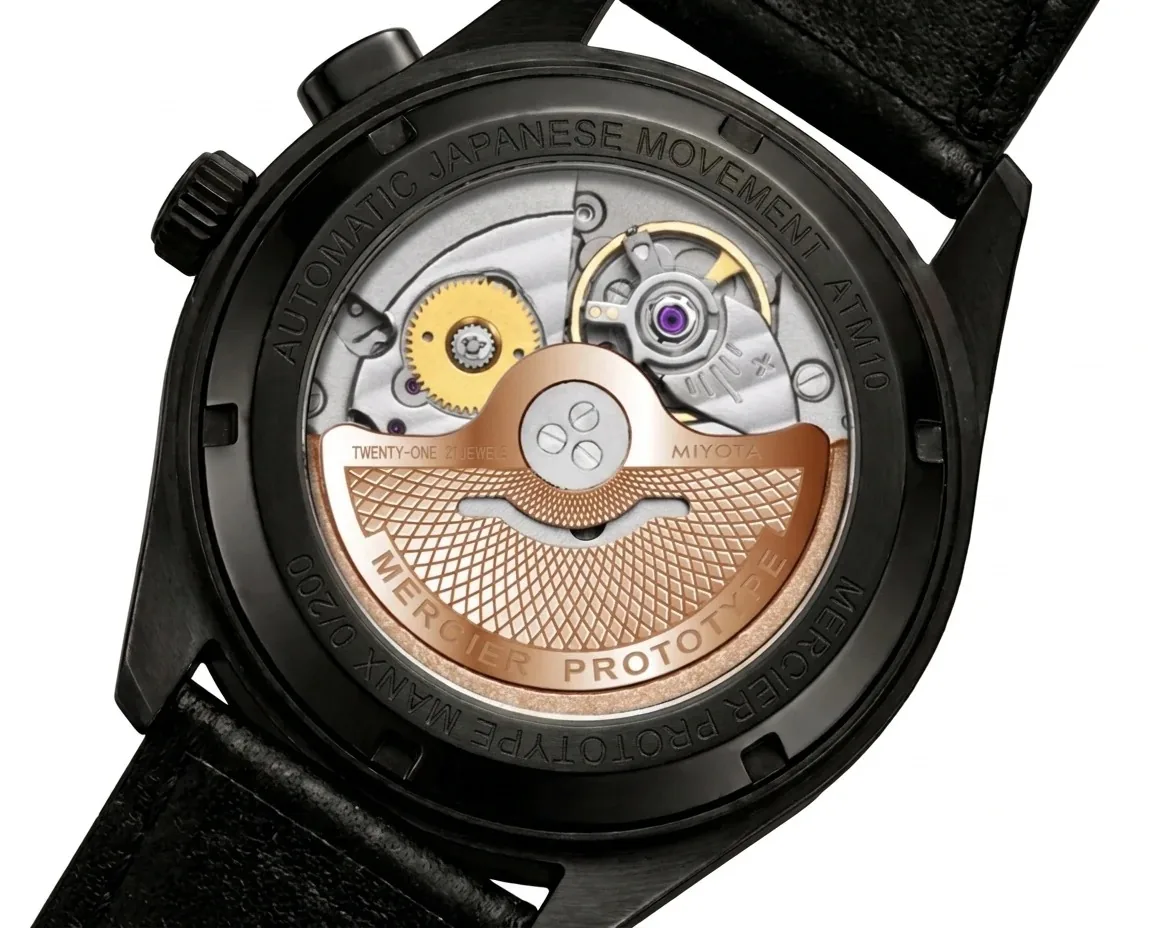
Watch movement design is the engineering of the mechanism that powers and regulates a watch. Designing a complete watch also means fitting that mechanism into a readable, wearable object. Those are connected disciplines, but they are not the same job. A finished drawing is not evidence that either job is finished. This manufacturing overview explains the stages.
As an independent brand, we think this distinction deserves more space than it usually gets in a product description. A named caliber tells you something useful. Vague language about craftsmanship does not tell you who designed the mechanism or what the watchmaker actually changed.
Watch movement design starts with constraints
Consider the Miyota 9122 used in the Manx. Miyota specifies its functions, movement dimensions and technical drawings, including the relationship between the hands, crystal and case. The manufacturer explicitly notes that clearance changes with the glass, case structure and hand length. Read the 9122 technical documentation.
That is a useful example of why a dial is not a blank canvas. If the mechanism supplies a day display in one position, the dial must work with that position. If the hands need a particular amount of space, the case and crystal must accommodate them. A pleasing sketch still has to respect the physical assembly.
A caliber and a complete watch solve different problems
The movement engineer has to make energy delivery, gearing and regulation work together. The watch designer has to integrate the movement, case, dial and external parts into a coherent object. Manufacturing then has to reproduce the design consistently; assembly and adjustment are additional stages, not things a rendering proves. IWC describes those separate development and production steps.
Our perspective is that using an established caliber does not remove the design work. It changes its boundaries. For the Manx, the honest description is a watch built around the Japan-made Miyota 9122, not a movement that Mercier invented from scratch. The product page identifies that movement openly.
A smaller change can affect the whole watch
The Manx’s calendar layout is a practical illustration. The subdials need to show useful information, while the main hands must remain easy to find. The two functions share a small area. We see that as a design balance rather than an invitation to add as many indicators as possible.
Change the visual weight of an index or the contrast of a hand and the watch may read differently, even if the mechanism is unchanged. Compare our Noir and Blanc photographs to see how the dial treatment changes the impression of the same basic watch. Appearance is not independent of function when the function is something you have to read.
Why the work does not end at the prototype
A working prototype and a design ready for series production are different milestones. IWC’s account describes prototype qualification, testing and a pilot run before series manufacture. That is an example of its process, not a claim that Mercier uses the same test program or equipment. Read its explanation of qualification and production.
For a buyer, the useful lesson is to ask specific questions. What movement is installed? Which functions does it actually provide? Are the dimensions published? What does the warranty cover? Those questions give you more to evaluate than an attractive image or an undefined claim of perfection.
For us, the ambition is to make the finished object feel as deliberate as the original idea. That calls for patience with details and clear language about what the product is. It is not a reason to blur the difference between a calendar display and a more complex complication.
Why the Manx
The Manx combines a named Miyota 9122 with a black-PVD case, domed sapphire crystal and day-and-month displays at $795. Its individual numbering and five-year limited warranty are part of the current offering, which you can review on the collection page.
We want you to appreciate the whole watch without having to guess at its origin or functions. Start with the specifications, explore the photographs, and choose it because those decisions make sense to you.
Explore the Manx
Compare Noir and Blanc, read the specifications and find the dial that feels like yours.
Compare the Manx